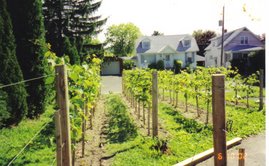
I thought I would try something different. I have been wanting to include video of my vineyard and some of the techniques I use to grow grapes and make wine. To get started with it I experimented with some video of winemaking from back in 2004. My friend Rich Schell and I make wine together every year. Before planting my vineyard in 2001 we purchased all of our grapes from a local importer of California grapes. We still purchase some every year but now we also have our "estate grown" grapes from Villa Ruzzo Vineyards, my backyard of course.
In the video I've uploaded from 2004, we are making Zinfandel. We bought 288lbs(8 crates ) of Zin and went to town. In the video you'll see the old Italian way of crushing the grapes. We've since gone hi-tech, but that was a lot of fun. If this "test" video uploads and works, I'll put something together with video of my vineyard. This one is rough and it's a little dark. At the time we filmed it we weren't thinking about adding it to a blog. We just wanted to have some video of our winemaking to look back on and laugh. So please forgive the poor quality. What I'd really like to do in the near future, is make videos by subject and upload them. The first one will be on pruning and I plan on completing it in the spring of 2008 and then I'll upload it. I'm very much an amateur at making these videos and editing them . I'm sure I'll get better along the way but "you gotta start somewhere" right? Hope you enjoy it!
Friday, January 11, 2008


Wednesday, January 9, 2008
2007 Villa Ruzzo Riesling
 I really love red wine, but I love white wine too. After the first few successful years of my vineyard and in particular my Cabernet Franc vines, I realized it was time to expand and plant some white wine grapes. I was again faced with the dilemma of deciding which variety. I tasted through a whole bunch of French-American hybrids like Vignoles, Seyvel Blanc, Aurore, Vidal and the like. I've always liked these hybrids. As a matter of fact the White hybrids are excellent and compare well with white viniferas. But since I had some success with Cab Franc I checked on the cold hardiness and growth characteristics of some white vinifera varieties. The ones that seemed to hold promise were Chardonnay, Pinot Blanc and, to my surprise, Riesling. I say this because I didn't want to grow Chardonnay. I just don't like it well enough and I would have chosen Vidal Blanc or Vignoles instead. Pinot Blanc was a possibility but Riesling... now Riesling has always held my interest of all the white wines I've ever tasted. It's steely acidity, hints of tropical fruits, green apple and the haunting aroma of petrol. I love it! If I could grow it in my backyard...no way! I did some more research and was thrilled to find out it is the hardiest vinifera white, hardy to nearly -10F and it can survive down to almost -16F. The most encouraging news was though, that some of the world's best Rieslings are being grown just 200 miles or so from my house in the Finger Lakes. And the variety ripens earlier than Cab Franc.
 That was it, Riesling it was. I planted 10 vines just to make a few gallons and it has been the easiest grape to grow and make wine with. It seems no matter what the weather is or what the numbers come in at, the wine is always good. The exciting thing is, just like the other varieties, I think this year's fruit gives me a shot at not just good wine but, dare I say, great wine. It was sweet, clean and balanced. I simply can't wait to see how it turns out. I'm very happy so far.
Here are the numbers:
Brix: 21
TA: .6
PH: 3.38
The quality and taste of the juice was unprecedented for grapes from my vineyard, or even grapes I have purchased in the past. We'll see if my skills in the cellar can coax the best from this delightful fruit produced by God and Earth . I hope I know what I'm doing.
Thursday, January 3, 2008
2007 Villa Ruzzo Cabernet Franc
 My quest to grow grapes worthy of making great wine caused me to be willing to experiment and take risks. The biggest risk was deciding to try and grow some vinifera vines when I planted my vineyard. Although everything that I read and researched told me I couldn't do it because of my winter lows and too short a growing season, I tried anyway. I did a lot of research and found what I determined to be the only red bordeaux grape that had a chance here: Cabernet Franc. It is one of the three main grape varieties that comprise a classic Bordeaux wine or an American Meritage(the Bordeaux style but grown in the U.S.) along with Cabernet Sauvignon and Merlot. It is actually a genetic parent of Cabernet Sauvginon along with Sauvginon Blanc. It produces a much less tannic, lighter red wine than Cab Sav and a bit more herbaceous in character. It generally makes up the smallest percentage of the Bordeaux stlye blend. The best ones however, can be excellent and there are parts of the Loire Valley in France where it is the primary part of the blend. I have had some excellent "old world" style Cab Francs as a single varietal wine from the Long Island and Finger Lakes regions of New York State, as well as some more "fruit forward" New world style Cab Francs from California. I like them from both coasts for their respective characteristics. The variety just happens to be the most winter hardy of all vinifera varieties. It can survive well between -5 and -10F with minimal bud damage and the vine will not be killed until temperatures drop lower than -16F. It also ripens earlier than many red wine varieties including Cabernet Savignon. My only concern was that weather records showed a -28F record low for my City in upstate New York.
I was hoping to achieve something along the lines of the Long Island versions since I liked them the best. My climate here is closer to the Finger lakes in the winter, but Long Island in the summer with the big exception of the fact that there is no large body of water near me to lengthen the ripeneing period by moderating temperatures in the late fall, when the water holds some heat and delays the first killing frost for a couple of weeks. I had read that some growers in places like Minnesota take their vines down off the trellis and bury them under a layer of dirt due to winter lows that prevent the growing of fine wine grapes. I figured hey it's only five vines, these guys are burying hundreds or thousands. No problem! And it wasn't, the first year. It didn't take me long at all an hour or two maybe. The vines came through with flying colors. Then I had a great idea; I was struggling to keep ten of the original vines I planted healthy. The variety was Chancellor another French-American hybrid that was very susceeptible to fungal diseases. So I ordered 25 more Cabernet Franc vines and in the spring I ripped out Chancellor and replanted with the Cab Franc. They grew nicely but pruning them down and burying them now that there was 30 was a lot of work. I did it for three years and as the vines got bigger, it got even harder. There was also the problem of a very short window of opportunity between leaf drop in late October/early November and the time the ground froze solid in mid-December. Especially when you only have weekends to get it done.

The coldest temperature I have recorded in my backyard since I planted my vineyard is -17F. Fortunately I had the vines burried that year. But there have also been three years when the temperature never dropped below zero. The bottom line is I have stopped burrying the vines. Instead, I have devised a riskier but much easier method. I leave the vines up on the trellis and do what is done in the Finger Lakes - I "hill them up". Basically I mound up dirt around the base of the vines over the graft union. That is where the "Cab Franc wood" is grafted to the rootstock. This way if the worst happens and the whole vine is killed by low temperatures, you can regrow from the ground up. Then I take it a step further. I also let the vine grow a sucker each year, which is basically a shoot from the base that could be another trunk. Since the shoot is so thin and flexible it is very easy to bend down and pin to the ground before winter. If winter temperatures don't cause any damage, I'll just prune it off in the spring and grow a new one for next year. After "hilling up" I blow any snow from my driveway throughout the winter, onto the vines to add a layer of insulation to the vines for further protection. Is it a perfect method? No, but so far I have had a full crop every year. There is still the possibility I could have 100% kill of everything exposed to cold air if the temperature drops low enough, but that's where the extra shoot/trunk will come in. It will at least give me a small crop the next year and a full crop the year after. So far my risk has paid off. I better watch my tongue, it's only January!
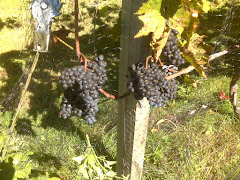
This year was the very best quality fruit I have taken from the vines. It was clean, disease free and very dark blue (as you can see above). Here are the harvest numbers:
Brix: 22.5
TA: .55
PH: 3.51
Not bad for our frosty and unforgiving climate Huh? The wine tastes great so far, but we'll know better in about six months. I'm very excited though, maybe I'll be the first person to make a good red vinifera wine in the Capital Region of New York State. Now that would be something.
Monday, November 5, 2007
2007 Villa Ruzzo Marechal Foch
 In planning my vineyard back in the year 2000, I knew something about wine making but nothing about what, if any grapes could be grown for wine making in the Capital District of New York State. I did a lot of research online and I looked to local vineyards for guidance. There were exactly one (1) vineyards growing wine grapes within an hour of my home. "This is not a good sign" I thought to myself. The next obvious question was, "why?" I was fortunate enough to stumble across the Cornell University website which just happens to include a plethora of viticultural information. This is due to the Finger Lakes AVA grape growing region. This AVA (American Viticultural Area) I found to be the most similar to the climate in my backyard. Using online historical weather databases, the information all said "you can't grow high quality wine grapes in your backyard." I guess that's why there was only one tiny little nothing of a commercial vineyard anywhere near my house. "Great, now what?" Because I was NOT about to give up on my plan for a home vineyard! So I read, and I read, and read some more. I went from having no idea what the difference was between the grape varieties used to make a French Bordeaux and a California Meritage. (there is no difference for the most part) I learned that most European wines are not named after the varietal that they are made form, while most new world wines are. I learned about the red varietals: Cabernet Sauvignon, Cabernet Franc, Merlot, Malbec, Syrah, Zinfandel/Primitivo, Sangiovese, Gamay, Pinot Noir, Petit Verdot, Tempranillo just to name a few. The white varitetals: Sauvignon Blanc, Chardonnay, Riesling, Viognier, Pinot Grigio, Pinot Blanc, Semillion, to scratch the surface. I had made wine from some of these varietals like Cabernet Sauvignon, Zinfandel and Merlot. I purchase these from a local distributor who imports California grapes every September. I had also come to appreciate many different commercial wines over the years. The conclusion that all the current knowledge had drawn me to though was this: Sadly, I could not grow the type of grapes I needed to make the types of wine that I love to drink. What and indescribable let down that was. You see, all the available expert advice coupled with the historical meteorological data said that Vitis Vinifera, the grape used to make the highest rated wines (ie; Cabernet Sauvignon, Sauvignon Blanc etc.) could not handle the climate in New York's Capital Region.

I was crushed ( no pun intended), yet determined not to give up. Along the way, I had read about French-American Hybrids. These were exactly what their name implies; hybrids of Vitis Vinifera (wine grapes) and the cold hardy, disease resistant native American varieties, which make great jelly and juice, but terrible wine. Without going into way more detail than I already have, these varietals were created during the late 1800's in an effort to develop wine grapes that could resist the phylloxera root louse, an unintentionally imported American pest that pretty much wiped out all of France's vineyards at that time. These hybrids combined the natural phlloxera resistance of the American vines with the superior wine quality of the European vines. The problem was later resolved by grafting European vines onto American rooststocks. An unintentional feature of these hybrids though, was much hardier cold tolerance. You see Vitis Vinifera requires a long warm growing season and winter lows not colder than say 0 to -10 degrees Fahrenheit. I researched the record low in my area and found it to be -28 degrees Fahrenheit. Not good for me. This is where Cornell University came in to play. I learned about varieties like Chambourcin, Chancellor and Marechal Foch. These grapes could handle the cold, were planted widely in the Finger Lakes and Canada, and made into commercial wines.
 Next I went out to local wine stores and found these wines. I tasted and became depressed. I just didn't like them nearly as much as Cab's and Zin's. I tried really hard to like them cause I really wanted to grow wine grapes in my yard. The only one I seemed to be able get a little excited about was Marechal Foch. That, in a huge nutshell is was what led me to select it as one of the varieties I first planted. Every year so far, the grapes have ripened nicely and come in with good sugar and acid levels for wine making. The problem for me has been that if you try to make wine with these grapes like you would make Cabernet Sauvinon or other vinifera grapes, it tastes funky. So I have spent the past 5 years trying to figure out how to make the best wine possible with these grapes and I think this year may be the year. It really helps that the weather was great and the fruit that came in from my Foch vines was just perfect as the above pictures show. For you winemakers here are the harvest details:
Harvest Date: 9/26/2007
Brix: 24.2
TA: .6
PH: 3.59
These numbers coupled with the taste and condition of the fruit, have me very excited about the wine potential. So far the early results are super promising. I'll keep you posted along the way.
Harvest -Finally!!

Harvest is now complete and the grapes are safely in the cellar being turned into wine. This post is long, long overdue, but that just reflects the demanding nature of viticulture. Harvest is a very demanding time of year (seems like I say that about every phase of grape growing) because of the delicate balance between the ripening grapes and the weather. I grow four different varietals and they all ripen at different times during the fall. This requires that you be ready to harvest them on the exact date that they are ready. The problem this presents here in the Northeast United States is that it is by no means an exact science. Each year different weather factors and growing conditions effect the life cycle of that particular year's crop. For example, the weather in the month of April will determine when budbreak will occur. Warmer weather will cause buds to break sooner while cooler weather means a later budbreak. Each variety has a required number of "growing days" to harvest. My varieties; Cabernet Franc, Riesling, Regent and Marechal Foch range from approximately 150 to 180 growing days to harvest. Of course, the weather can have a huge impact on those numbers. Especially does the fall weather influence grape ripening and quality. The more warm sunny weather you get in September and early October, the better quality your grapes will be. My previous post expands on this subject. I'm happy to report that this year's harvest was the best in the 8 year history of my vineyard! I will compose four posts to follow that will highlight the harvest details of each of my four varietals. But let's just say that I have super high hopes for the 2007 vintage wines. Depending on how the wine making process goes, I may even enter some of them into some amateur wine making competitions. That's a big step for me, one I have yet to take after 15 years of winemaking and 8 years of grape growing.
Sunday, August 26, 2007
Let the Sun Shine!

During and after verasion a winegrower becomes neurotically aware of the sunshine. My wife can't stand it because this time of year my moods are actually influenced by the weather report. When the forecast calls for warm sunny days, she loves me. If the dreaded cloudy, or worse yet rainy forecast is called for, however, she plans to spend time away from me! You see, this is the time of year when you need as much sunshine as possible to raise the brix(sugar content) of your grapes to adequate levels for wine making. For red grapes that is generally 22-24 brix and for white wine 20-23 brix will usually be sufficient. The sun does more than build sugar levels though. The sun shining on the clusters themselves actually contributes to something called phenolic ripeness. This means that not only do the grapes have sufficient sugar for wine making, but they are physiologically ripe. There are no vegetal flavors, harsh, green tannins are gone. Fruit flavors are at a maximum and the grapes will make delicious wine. It is entirely possible for grapes to have enough sugar, but still be unripe. That's where hang time comes into play. That is the difficult and subjective period when the grapes have achieved a fairly good level of ripeness but they are not quite ready to pick, so they must hang for days or weeks longer until they reach phenolic ripeness. During this time the birds, bees, deer and lots of other pests would love to get their greedy paws(beaks, antennae, whatever) on your precious crop. Again, this is where watching the weather is crucial. Nicely ripened grapes that are just about ready can be ruined by a soaking rain. The grapes will soak up the water and become diluted. They may swell and split open only to become infected by gray mold, sour rot or unwanted botrytis. This time period is so important and it's really exciting. The whole vintage comes down to these final weeks and you continue to hope for the best and try to avoid the worst. The most important decision is still more than a month away for me, that is the day to begin the harvest. It will be different for each grape variety since they all ripen at different rates. It's all so stressful! And to think: I do this in my spare time for relaxation and pleasure? I need my head examined.
Friday, August 3, 2007
Verasion -A Test of Patience

Second only to the last few months of winter, the most difficult waiting period for a wine grower is the time just prior to verasion (when the grapes soften and change color). In the preceding weeks you have been waging a seemingly endless war against fungus and insects, keeping the canopy healthy and open, as well as making sure the grapes are exposed to a good deal of sunlight. You have watched the grapes reach full size, and it just seems as if nothing else is ever going to happen. Every day you inspect the bunches and check for the slightest change in color and still nothing. Is something wrong, you begin to wonder, they were changing by this time last year. What's going on here! Then finally one day, you notice something on a few of of the berries. Is it black rot? Anthracnose? Some downy Mildew that you've missed? No, wait a minute these grapes are turning! It's here it's finally here, verasion. What seemed like it was never going to happen has begun, the grapes are ripening. It's a wonderful sign of good things ahead. Now I just have to get the nets up to keep the birds away. You gotta love it!
Subscribe to:
Posts (Atom)

 Posts